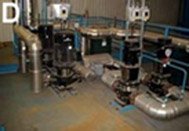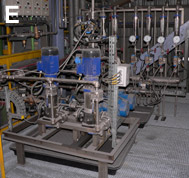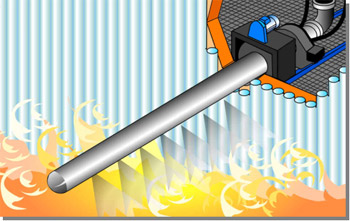

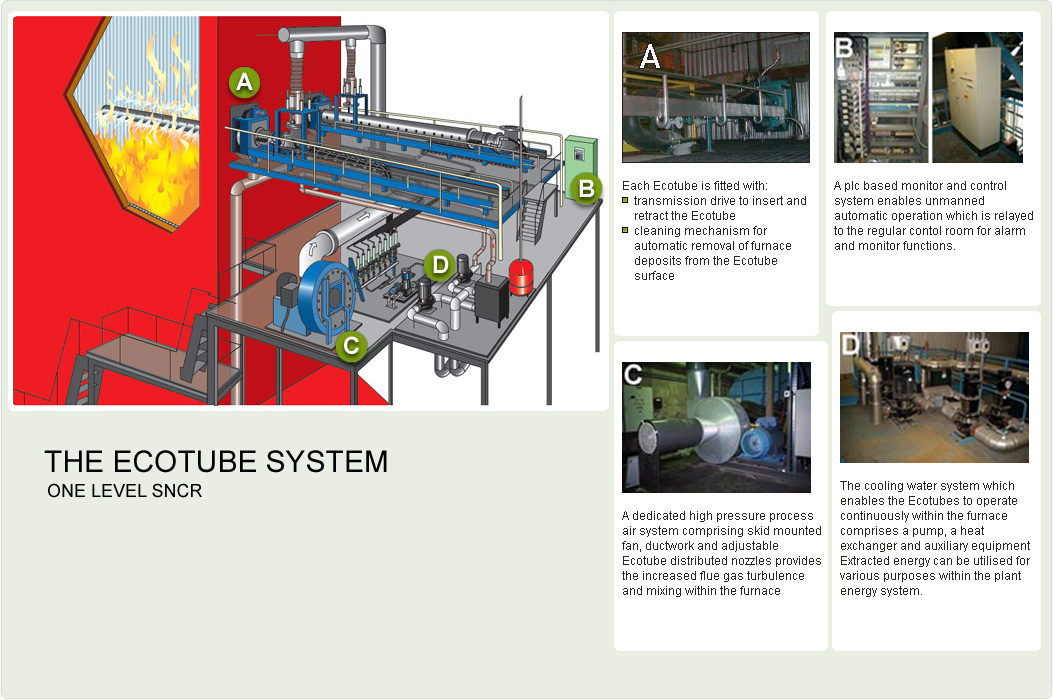
The first Ecotube System was installed in 1995 and has been installed in Waste to Energy boilers (10-85 MWth), Biomass and Coal boilers (25-270 MWth)
Installation Results:
- 30-90% NOx reduction
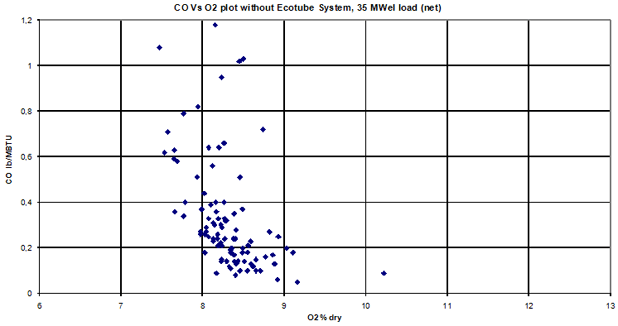
- 30-90% CO reduction
- 10-30% reduction of flyash
- 5-10% increased boiler load
- Reduced maintenance costs
Combustion Problem Areas are:
• Poor mixing/laminar flue gas flow
• Uneven temperatures and gas velocities
• Non utilized furnace volumes
• High NOx
• Frequent CO spikes
• High SNCR reagent consumption
• High ammonia slip
Financial Benefits
• Increased waste throughput
• Increased steam flow
• Reduced flue gas flow
• Reduced fly ash carry-over
• Reduced flue gas temperatures in convection pass
Environmental Benefits
• Reduced emissions of NOx, SOx, CO, NH3 and CO2
• Increased residence time in temperatures >850°C
• Radically improved mixing
• Distruction of laminar gas content
• Reduced NOx, CO, SOx, HCL and particles
• Lower stoichiometric ratio possible
A typical project follows the steps outlined below. The advantage with this approach is that we take one step at a time and start with a small project to assess problems and possible solutions. Hardware installation can also be done in stages, with the option to stop after any level on the technology ladder with a fully functional installation in place. The levels on our technology ladder are: Ecotube (which can be air staging only or complemented by SNCR, flue gas recirculation or humidification), DOS and Ecotube Zero. When the conditions to move on to the next level are right, the earlier installation becomes a fully integrated part of a future system.
This is a desk study based on operational parameters provided by the client. A report will be provided where we visualise our findings from analysis of the data with suggestions for the best way to improve the plant performance. This will include a suggestion for implementation of our technology ladder to a suitable level, but will also discuss alternative technologies.
The next step is a more in depth analysis of the plant based on a site survey and measurements using our in-furnace probes for video filming, gas sampling and temperature measurements. A deeper analysis of the data is presented and we will provide a firm quote for any suggested work based on ECOMB technology.
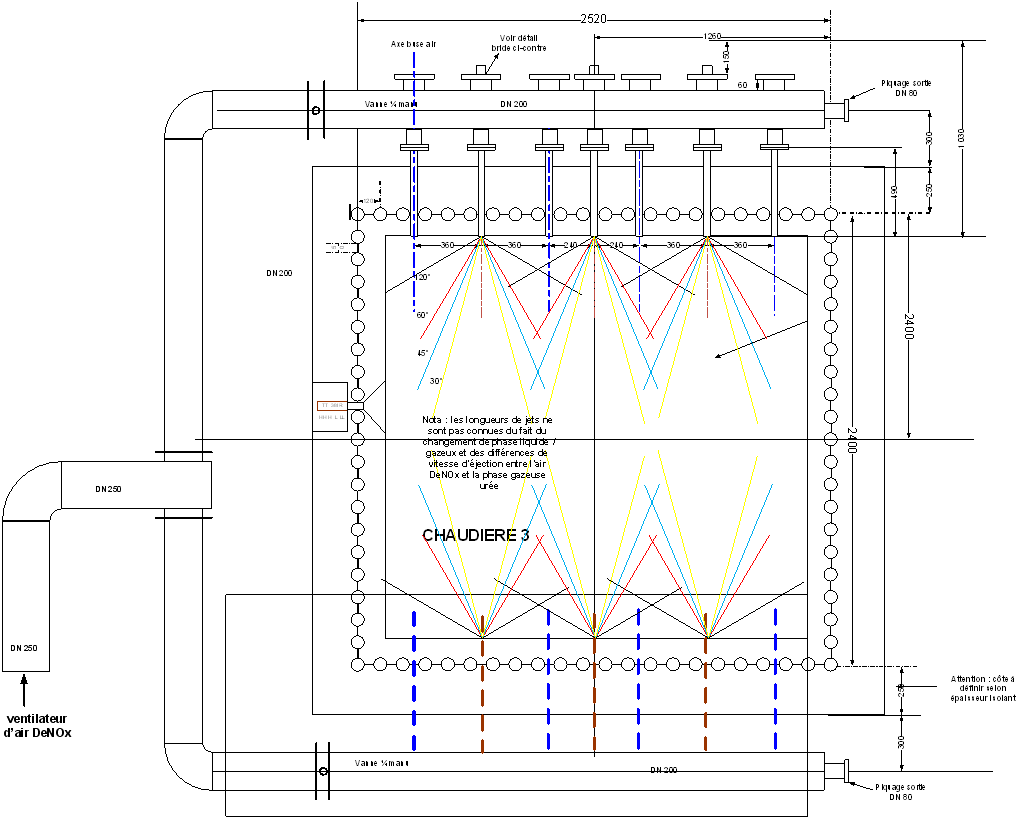
Ecotubes can operate with air only to provide a deeper and more precise staged combustion combined with better mixing of the gases in the combustion chamber. This will normally result in lower CO and NOx emissions and higher plant efficiency as the amount of excess air can be reduced. For higher NOx-reduction (70-75%), we can equip the Ecotubes with SNCR-nozzles for ammonia or Urea injection. Flue gas recirculation and humidification are also options that can be included.
Deep Oxygen Staging takes the Ecotube technology one step further by replacing some or all Ecotube air with oxygen. This will be economical a for plant with an electrolyser in the vicinity. Most electrolysers operate as hydrogen generators, with approximately 8 kg oxygen per kg of hydrogen produced as a by-product that often is not used. The Ecotube DOS system can put this oxygen to good use and will improve combustion efficiency as well as reducing the NOx-emissions even further.
This is the final step on our technology ladder. By replacing all combustion air with recirculated flue gases enriched with oxygen gas from an electrolyser, the nitrogen in the flue gases from combustion with air is replaced with CO2 that can be captured in a CCS-installation. This will be a much smaller installation than what is required for a conventional plant as the CO2 - concentration in the flue gases will be over 90% compared to 15-20% in a conventional plant.
After an installation, we offer a period of plant performance monitoring. This takes the shape of a periodic report which analyses the performance of the plant with our comments and suggestions. This can be combined with video conference meetings where we present the latest performance report and discuss any problems and potential actions to improve the performance. Typically this would be on a weekly, two-weekly or monthly basis as preferred by the client.
Significantly improved combustion performance due to improved flue
gas mixing etc
NOx, SOx, CO, O2 reduction
Flue gas flow reduction
Increased residence time in temperatures >850°C
Increased boiler efficiency
Fly ash reduction
Read more about Ecotube Air Staging
NOx reduction
Read more about Ecotube SNCR
NOx reduction
O2 reduction
Flue gas temperature reduction
Read more about Ecotube FGR
Local temperature reduction
NOx reduction
Increased waste throughput
Slagging reduction
With the Ecotube SOx reduction technology a dry sorbent is injected via the Ecotube System into the upper part of the furnace to react with the SO2 in the flue gas.
A finely grained sorbent for example Limestone is distributed quickly and evenly over the entire cross section in the upper part of the furnace in a location where the temperature is in the range of 750-1,250°C. Limestone (CaCO3) or hydrated lime (Ca(OH)2) can be used as sorbent. The sorbent reacts with SO2 and O2 to form CaSO4. This is later captured in a fabric filter or ESP together with unused sorbent and fly ash. As with NOx reduction technology systems, reduction rates ultimately depend on an even distribution of the sorbent in the flue gas in combination with proper mixing together with the flue gases. Reaction times for SOx reduction are 1-2 seconds. The Ecotube SOx reduction technology can be implemented on different boiler elevations to deal with part load conditions.
Removal efficiency is greatly improved compared to traditional wall injection systems due to better mixing and better penetration of the solvent. Fine sorbent particle size and an even distribution of the sorbent over the cross-section of a boiler significantly improves the process performance.